

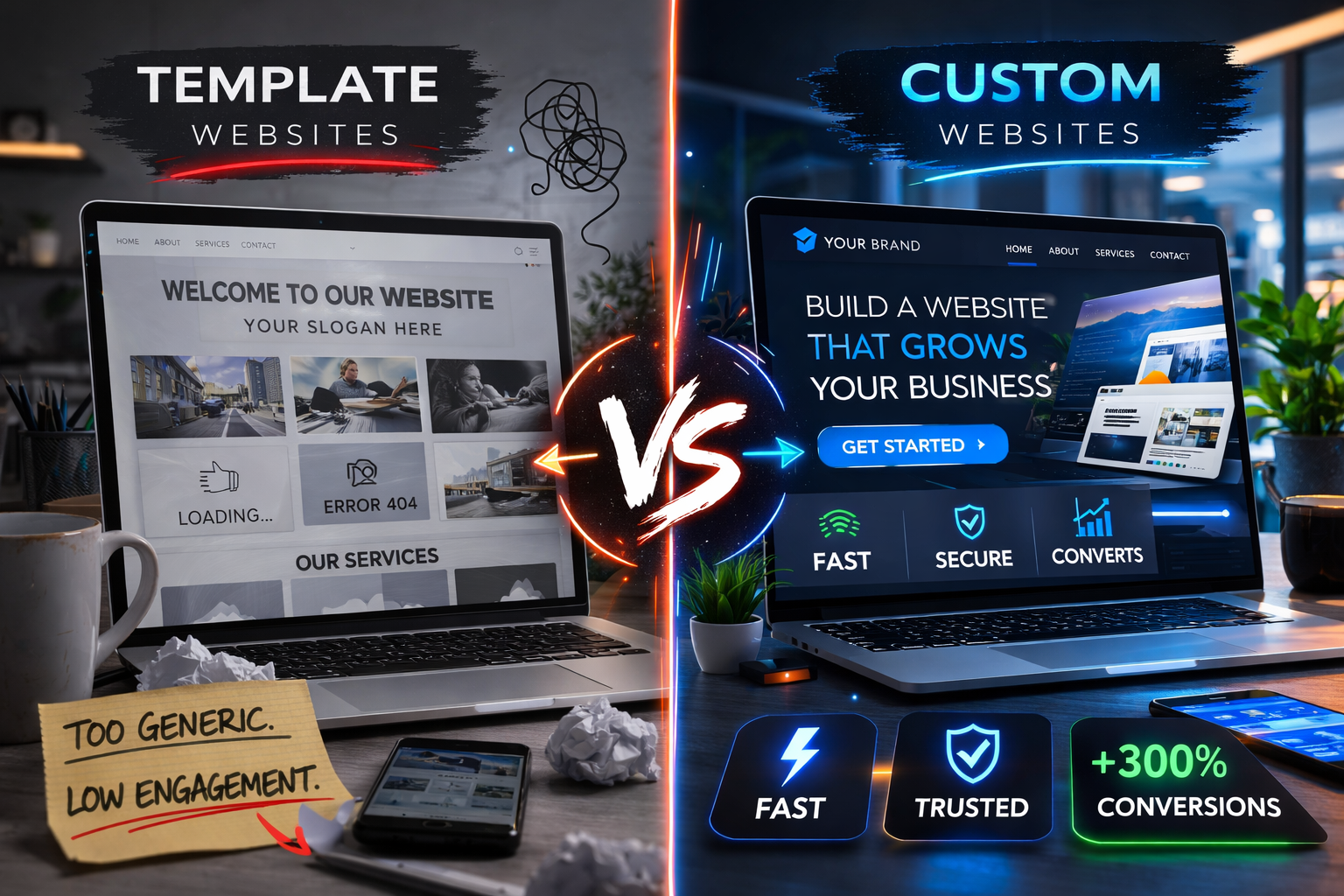
7 Signs Your Business Needs a Custom Website (And Why Templates Won't Cut It)
Your website isn't a brochure. It's your highest-performing salesperson, your brand's first handshake, and — for most prospects — the only thing standing between curiosity and conversion. So why are so many growing businesses still running on cookie-cutter templates that were never designed for their customers?
Here's the uncomfortable truth: users judge your site's credibility within milliseconds, with 94% of first impressions based on design alone. If your website looks like every other business in your industry, you're already losing the credibility game before a single word gets read.
Templates have their place. They're quick, affordable, and perfectly fine for a side project or a brand-new startup testing an idea. But there's a tipping point where a template stops being a stepping stone and starts becoming an anchor. This post breaks down the seven clearest signs your business has outgrown its template — and why a custom website is the investment that pays for itself.
Sign 1: Your Custom Website Would Stand Out, but Your Template Makes You Invisible
Have you ever Googled a service provider, clicked through three or four results, and noticed that every site felt... the same? Same layout. Same stock hero image. Same button placement. That's the template problem.
Templates and themes are designed to appeal to as many customers as possible, which means they're rarely the perfect solution for any one business. When you're using the same Squarespace or WordPress theme as thousands of other businesses, differentiation becomes nearly impossible. One popular WordPress theme has sold over 300,000 copies at $59 each — meaning your "unique brand identity" could be running on the exact same chassis as tens of thousands of competitors.
Think about what that means for trust. 75% of consumers admit to making judgements on a company's credibility based on their website design. A custom website lets you craft every pixel around your brand voice, your specific audience's expectations, and the unique value you bring to market.
When This Matters Most
- You're in a competitive service industry (legal, financial, consulting, healthcare)
- Your brand positioning relies on being premium or differentiated
- You've invested in brand strategy but your website doesn't reflect it
- Your competitors' sites are virtually indistinguishable from yours
Sign 2: Your Site's Performance Is Hemorrhaging Revenue
Slow sites don't just annoy visitors — they cost real money. Website conversion rates drop by an average of 4.42% for each additional second of load time between seconds 0–5. And a Deloitte study found that even a 0.1-second improvement in site speed increased retail conversion rates by 8% and customer spending by 10%.
Template bloat is one of the biggest culprits. Templates carry lines upon lines of code and features that exist solely to make the template flexible for a wide range of people — and all that extra weight slows your website down. Your template loads dozens of scripts, stylesheets, and plugin dependencies that your specific site doesn't even use.
Amazon estimated that a 1-second delay in page load would cost them $1.6 billion in annual sales. You're obviously not Amazon, but the proportional impact applies. Portent's research found that a site loading in 1 second has an e-commerce conversion rate 2.5x higher than a site loading in 5 seconds.
A custom website is built lean and intentional. Custom web design is built entirely around your needs, making it purposeful, with load times optimized from the code level — no unnecessary plugins, no generic framework overhead.
Quick diagnostic: Run your site through Google PageSpeed Insights. If your mobile score is below 70, bloat is likely the problem.
Sign 3: You Can't Integrate the Tools Your Business Depends On
This is where growing businesses hit a wall fast. Your CRM, your booking system, your inventory management, your marketing automation — these tools need to talk to your website. Templates make this painful.
Most template websites are built to fit everyone, not to support a business that's scaling. Adding advanced features like AI chatbots, complex databases, or custom API connections can be extremely difficult within template constraints. Developers can implement advanced security measures and integrations tailored to your needs with custom code — but templates often restrict the necessary technology stack.
I've seen this scenario play out dozens of times: a company invests $3,000–$5,000 in a template-based site, then spends another $8,000 over the next year patching integrations together with plugins and workarounds. One SaaS startup founder spent $15,000 on a custom WordPress site only to realize three months later that it couldn't integrate with their product's API without a complete rebuild.
Integration Red Flags
- You're using Zapier as a duct-tape solution between your site and CRM
- Form submissions require manual data entry into other systems
- Your e-commerce checkout can't support the payment or shipping logic you need
- Third-party plugins conflict with each other after updates
- You've been told "it's not possible with this theme" more than once
Sign 4: Your Conversion Rate Is Flat Despite Growing Traffic
This one stings because you're doing the marketing work. Traffic is up. Ad spend is optimized. SEO is producing results. But leads? Revenue? Flat.
A good user experience (UX) design can increase conversion rates by up to 400% compared to a poorly designed site. That gap isn't just about copy or offers — it's structural. Templates force you into rigid page layouts and user flows that weren't designed for your buyer's decision-making process.
Consider this math: A business pulling 10,000 monthly visitors at a 2% conversion rate gets 200 leads. Bump that to 4% with proper UX optimization and you get 400 leads — doubled output from the same traffic. At $500 per customer, that's $100,000 left on the table every single month.
UI design alone can boost website conversion rates by 200%. Custom websites let you:
- Design conversion paths around actual user behavior data
- A/B test layouts without template constraints
- Build unique landing pages tailored to each marketing channel
- Implement personalized content and dynamic experiences
Additionally, well-designed landing pages can improve conversions by 120%, and adding testimonials can increase purchase likelihood by 35%. These kinds of granular optimizations are nearly impossible within template frameworks.
Sign 5: Your Site Is a Security Liability
This isn't a hypothetical risk — it's a statistical certainty if you're running an outdated template ecosystem. 7,966 new vulnerabilities were found in the WordPress ecosystem in 2024 alone — a 34% increase over 2023. That's roughly 22 new vulnerabilities discovered every single day.
The scale is staggering. Security databases now track over 64,782 total vulnerabilities across the WordPress ecosystem. And 96% of those vulnerabilities were found in plugins, not WordPress core itself — the very plugins that template sites depend on for basic functionality.
Templates rely on popular plugins. Hackers know this. Every plugin is an attack surface. Every outdated theme is an open door. 43% of WordPress security defects uncovered in 2024 could be exploited without authentication, and 33% of uncovered bugs were not patched before public disclosure.
The business impact is severe. The average cost of a data breach in 2024 reached $4.88 million. And trust erosion compounds the damage: 69% of Americans have walked away from a purchase or sign-up when a site seemed untrustworthy, and 60% of consumers use fake personal information when they question a site's credibility.
Custom websites reduce this risk because:
- You own and control the entire codebase
- No third-party plugin dependencies with unknown security histories
- Security protocols are tailored to your specific architecture
- Attack surfaces are minimized by design
If you handle sensitive customer data — financial information, health records, personal details — this sign alone justifies the investment.
Sign 6: Your Mobile Experience Is an Afterthought
As of 2025, 63.15% of global website traffic comes from mobile devices (excluding tablets). Yet most templates treat mobile as a secondary concern — they "respond" to screen sizes but don't actually design for mobile behavior.
Templates load slowly on mobile because they pull unnecessary assets meant for desktop. Forms feel cramped. Key actions require too many taps. And 57% of internet users say they won't recommend a business with a poorly designed mobile site. That's not just lost conversions — it's lost referrals. Mobile users are also 5x more likely to abandon tasks if a website isn't optimized for their device.
Custom websites approach mobile fundamentally differently. Mobile flows are planned intentionally, not adjusted after the fact. Content hierarchy is simplified. Performance is tuned for real devices on real networks.
The Template Mobile Trap
Most templates use CSS media queries to rearrange desktop elements on smaller screens. That's responsive design, not mobile-first design. There's a critical difference:
- Responsive (template approach): Desktop layout → shrink and stack for mobile
- Mobile-first (custom approach): Design for mobile behavior first → enhance for larger screens
If your Google Search Console shows high mobile traffic but significantly lower mobile conversion rates compared to desktop, your template's "responsive design" is the bottleneck. With 72.9% of overall e-commerce revenue now coming from mobile, this isn't a minor optimization — it's a revenue imperative.
Sign 7: You've Outgrown Your Template and Keep Patching Instead of Building
This is the most common sign — and the hardest to admit. You've customized your template so heavily that it's barely recognizable. Every update breaks something. Your developer spends more time on workarounds than improvements.
Studies show that 60% of template sites require major rebuilding after 2–3 years. Templates cost less upfront but often require redesigns, upgrades, or migrations within just one to two years. Over a 5-year window, custom sites frequently deliver higher ROI despite higher starting prices.
Most founders have already invested thousands into a template. Starting over feels wasteful. So they patch and pray, watching competitors gain ground while their site becomes a liability instead of an asset.
Here's a practical framework for knowing you've crossed the line:
- Your last three "quick fixes" each took more than a week — Template architecture is fighting you
- You're avoiding features your business needs because the site can't support them
- Your developer says "it's not possible with this theme" more than once a quarter
- Plugin updates break existing functionality regularly
- You've spent more on patches in the past year than a custom build would have cost
Custom Website vs. Template: The Real Cost Comparison
Let's address the elephant: yes, custom websites cost more upfront. In 2025, custom websites average $10,000 to $100,000+ depending on complexity. Templates? The average template site costs $500–$5,000 depending on features.
But framing this as "template is cheaper" ignores the total cost of ownership. Factor in plugin licensing, security patching, workaround development, lost conversions from subpar UX, and the inevitable rebuild in 2–3 years. A custom website might cost more upfront, but it will usually deliver much better long-term value and serve as a valuable extension to your business.
| Factor | Template | Custom |
|---|---|---|
| Upfront cost | $500–$5,000 | $10,000–$100,000+ |
| Time to launch | Days to weeks | 8–24 weeks |
| Scalability | Limited | Built for growth |
| Performance | Plugin-dependent | Optimized from code level |
| Security | Plugin-dependent | Controlled codebase |
| 5-year TCO | Often higher (rebuilds) | Often lower (longevity) |
Custom-built sites also have a higher chance of getting 20–40% more organic and AI visibility due to clean code and optimized Core Web Vitals. When your website directly generates revenue, that SEO advantage alone can pay for the entire build within the first year.
When a Template Is Still the Right Call
Fairness matters here. Not every business needs a custom website right now. A template still works when:
- Your business model is clear and unlikely to change soon
- The website is mostly informational
- You rely on a small number of tools and integrations
- Speed to launch matters more than long-term control
- You're a new business validating a market
If you're a solopreneur testing a service offering or a local shop that needs basic contact information online — templates are perfectly fine. The mistake is staying on a template after you've outgrown it. That's when the seven signs above start compounding.
How to Make the Switch: A Practical Roadmap
If you've identified three or more of these signs, here's a phased approach to transitioning:
- Audit your current site's performance — Document load times, conversion rates, bounce rates, mobile vs. desktop metrics, and security vulnerabilities
- Map your integration requirements — List every tool your site needs to connect with (CRM, ERP, payment processor, marketing automation)
- Define your conversion architecture — Identify every path a visitor should take from landing page to desired action
- Choose your technology stack — Custom websites can be built with flexible frameworks like React, Next.js, or Django, tailored specifically to your business needs
- Plan for scalability — With proper planning, custom sites can accommodate growth without needing a rebuild every year
- Budget for ongoing optimization — A custom site isn't a "set and forget" asset; plan for iterative improvements based on real user data
Frequently Asked Questions
-
How long does a custom website take to build? Development timelines
vary based on complexity, but they're shorter than most people think.
Simple custom sites (5–15 pages) can launch in as little as 2–4 weeks.
Mid-level projects with integrations and custom functionality typically
wrap in 4–8 weeks. Even complex enterprise-level builds with heavy
integrations and advanced features rarely exceed 10–12 weeks when
working with an experienced team that has a proven process in place. -
Can I migrate my content from a template to a custom site? Yes, and you should. Content migration is a standard part of any custom build project. The key is restructuring content around new user flows rather than copying it over verbatim.
-
Is a custom website worth it for a small business? It depends on how central your website is to revenue generation. If your site is your primary lead source, the conversion improvements from custom UX typically deliver ROI within 6–12 months. If your site is a basic digital business card, a template may still suffice.
-
What about headless CMS options — are they a middle ground? Absolutely. A headless CMS (like Contentful, Strapi, or Sanity) paired with a custom front end gives you the content management ease of a template with the performance and flexibility of a custom build. It's becoming the preferred approach for mid-market businesses.
Your Website Should Work as Hard as You Do
The seven signs above aren't abstract concepts — they're revenue leaks. Every day your business operates on a website that can't keep up with your growth, you're losing conversions, eroding trust, and handing competitive advantage to businesses that invested in getting this right.
A custom website isn't a luxury purchase. It's infrastructure. With 81% of consumers unwilling to do business with brands they don't trust and trust now considered equal to price and quality as a purchase factor, the businesses that design for credibility and performance have a structural advantage.
Your next step: Run through the seven signs with your team. If three or more apply, start the audit process. Get specific numbers on your current conversion rates, page speed, and mobile performance. Those numbers will tell you exactly how much your template is costing you — and build the business case for a custom website that actually earns its keep.
For more context on how design affects user trust, the Nielsen Norman Group's UX research library offers an excellent evidence-based framework for understanding design's impact on credibility.
Suggested internal links: