
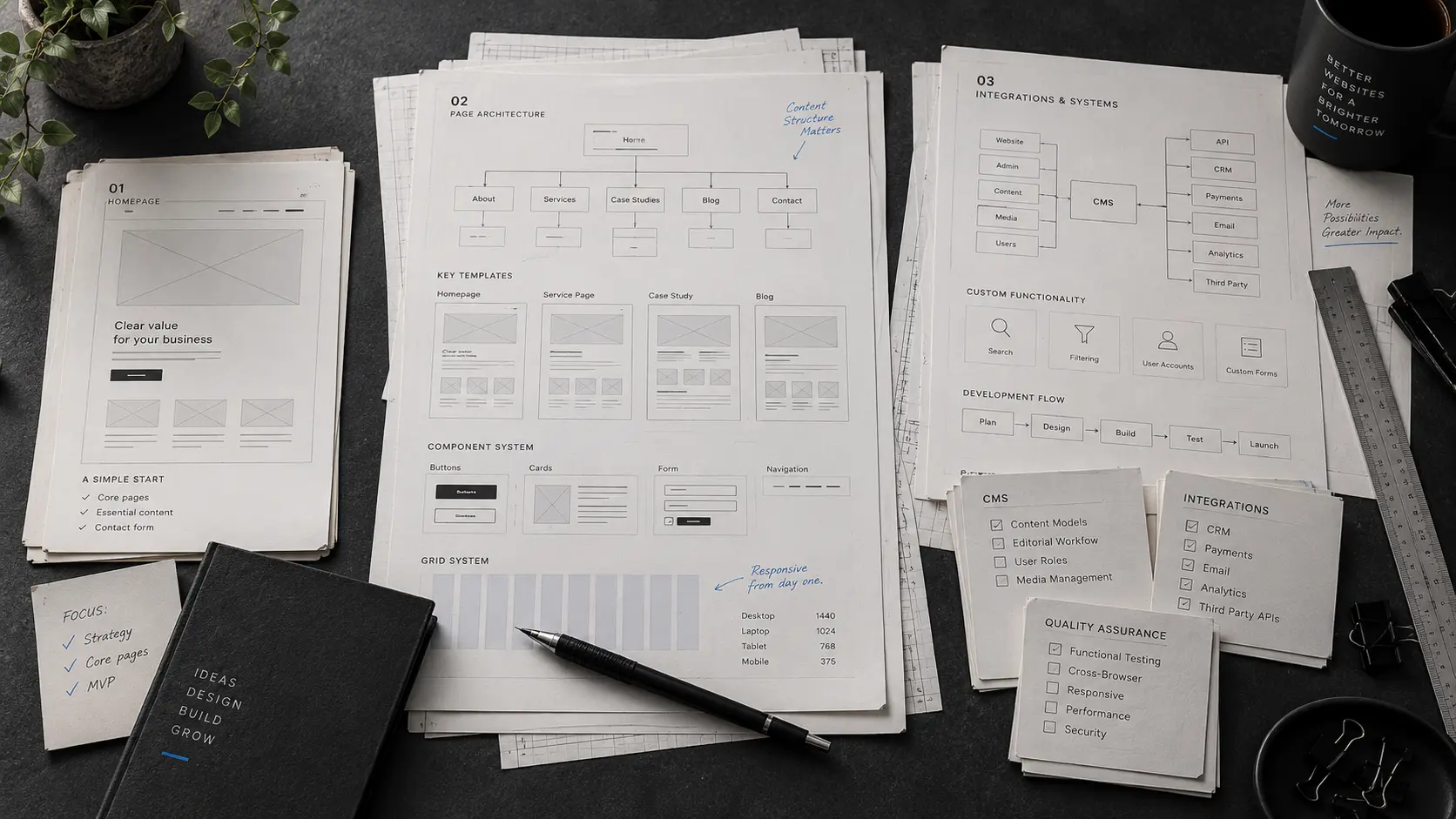
A professional business website in 2026 can cost anywhere from a few thousand dollars to tens of thousands, depending on what you actually need. A focused marketing site is a very different project from a custom website with a CMS, integrations, advanced motion, account features or complex business logic. The useful question is not “What does a website cost?” It is “What should this website do for the business, and what does it take to build that properly?”
There is no single “normal” website price
Two websites can have the same number of pages and still require completely different amounts of work. One might use a straightforward layout, supplied copy and a basic contact form. The other might need strategy, custom page structures, original copy, an editable CMS, CRM integration, animations, analytics, technical SEO work and multiple rounds of testing.
That is why pricing a website by page count alone can be misleading. Five simple pages can be easier to build than one highly interactive landing page. Scope matters more than the number in the navigation.
What does a business website cost in 2026?
A useful way to think about cost is by the level of problem being solved rather than by a fixed package.
- Template-based or very simple brochure website: often below $2,000, especially when most of the structure and content already exist.
- Professionally designed small-business website: roughly $2,000–$5,000 for a focused site with a clear structure, responsive design and standard functionality.
- Custom business website: roughly $5,000–$15,000 when strategy, custom UX/UI, stronger content structure, CMS work and conversion-focused flows are involved.
- Advanced custom website: $15,000–$30,000+ when the project includes integrations, custom content systems, advanced motion, complex forms, account areas or substantial technical work.
- SaaS product or custom web application: commonly starts above normal website budgets because the work includes product logic, user flows, data, permissions, dashboards, integrations and ongoing engineering.
Those ranges are deliberately broad. Geography, team size, specialist experience, project complexity and the amount of strategy included can move the final number in either direction.
What actually changes the price?
1. Strategy and information architecture
A website can be visually polished and still fail because the structure is wrong. Strategy work covers questions like: Who is this for? What does the visitor need to understand first? Which services need their own pages? Where should proof appear? What should the primary action be? Solving those questions takes time, but it usually makes the design process faster and the finished site more useful.
2. Custom design
Custom design means more than changing colors on a template. It usually includes a visual direction, typography, spacing systems, responsive layouts, reusable components and page compositions designed around the brand and the content. The more distinct the visual system needs to be, the more design time the project requires.
3. Development complexity
A static marketing site is relatively straightforward. Complexity rises when the website needs advanced forms, conditional logic, customer accounts, dashboards, search, filtering, payment flows, APIs, booking systems or integrations with other platforms. That work is software development, not just page building.
4. Content management
If your team needs to manage pages, services, articles, case studies, testimonials or other content without touching code, the website needs a sensible editing system. A well-planned CMS adds upfront work but can save a lot of frustration after launch.
5. Integrations
CRM tools, email platforms, payment providers, calendars, analytics, automation platforms and external APIs all add integration work. Some integrations are quick. Others require authentication, webhook handling, data validation, retries and proper error states.
6. Content and SEO foundations
A website cannot communicate clearly if the content is weak. Projects cost more when the studio is also helping with page strategy, copy structure, metadata, internal linking, structured data, content hierarchy and search-friendly page planning. That work is different from simply inserting finished text into a layout.
7. Motion and interaction
Good motion can make a site feel more deliberate, guide attention and improve the way sections connect. It also needs restraint. Custom transitions, scroll-driven sequences, interaction states and animation systems take more time than a static layout, especially when they need to work smoothly across devices.
8. Quality assurance
Testing is easy to underestimate. A professional launch should account for responsive behavior, browser differences, forms, validation, links, accessibility basics, performance, metadata, error states and real-device checks. Skipping QA can make a cheaper build expensive later.
Cheap website vs custom website: what are you actually paying for?
A cheaper website is not automatically a bad website. If the business has simple needs, a well-chosen template and clean implementation can be completely reasonable. The problem starts when a business needs custom thinking but buys a template-level solution and expects custom-level results.
A custom project usually costs more because you are paying for decisions as well as production: what to say, what to show, what to remove, how pages connect, how the experience changes on mobile, how content is managed and how the site should support the business after launch.
- Template work is usually faster because many design decisions are already made.
- Custom work gives more control over hierarchy, brand expression and user journeys.
- A custom CMS can match the way your team actually works instead of forcing your content into a generic structure.
- More complex development requires testing, error handling and long-term maintainability.
- A strong process reduces the chance of rebuilding the site again six months later.
How much should a small business budget for a website?
If the website is mainly there to establish credibility, explain a few services and collect enquiries, a lower custom budget may be enough. If the website is a major part of how customers discover, evaluate and contact the business, it deserves more attention.
A useful starting point for a serious small-business website is often somewhere in the $3,000–$10,000 range, depending on scope. That can cover a professional design system, responsive development, a manageable CMS, strong page structure and the technical basics required for launch.
Businesses with multiple services, complex content, integrations, custom interactions or a stronger digital sales journey may need to budget above that. If the website is effectively a product rather than a marketing site, the budget should be approached as software development.
What costs are easy to forget?
The build quote is not always the full lifetime cost. Ask what is included and what will continue after launch.
- Domain registration and hosting
- Ongoing maintenance and security updates
- Premium third-party tools or subscriptions
- Email delivery services
- Analytics or CRM platforms
- Copywriting and content production
- Photography, illustration or video
- Additional integrations requested after scope approval
- Long-term SEO or content work
- Future feature development
None of these are inherently a problem. The problem is discovering them after the project has already started. A good proposal should make recurring and optional costs clear.
How do you avoid overpaying for a website?
Overpaying does not simply mean choosing the highest quote. It means paying for work that does not serve the project, or paying twice because the first build was poorly planned.
- Start with the business goal, not a list of visual effects.
- Ask what is included in strategy, design, development and launch.
- Confirm whether content entry and CMS setup are included.
- Ask who owns the website, code and accounts after launch.
- Ask what happens when you need to update content later.
- Check whether responsive behavior is designed deliberately or simply scaled down.
- Ask how forms, analytics, SEO foundations and performance are handled.
- Request a clear scope so extra work does not appear as a surprise.
How do you avoid under-investing?
The opposite mistake is choosing the cheapest possible option for a website that carries real business responsibility. If prospects use the site to decide whether they trust you, compare your services or send an enquiry, the experience has value beyond simply “being online.”
Saving money upfront can be sensible. Rebuilding a weak site a few months later because the structure, CMS or technical foundation does not work is usually not.
When is a website redesign worth the cost?
A redesign is worth considering when the current website is actively getting in the way rather than simply looking old.
- Visitors struggle to understand what the business actually offers.
- The site looks acceptable on desktop but feels awkward on mobile.
- Important proof, case studies or testimonials are hard to find.
- The team cannot update content without developer help.
- Forms or enquiries regularly break or create unnecessary friction.
- The brand has changed but the website still reflects the old positioning.
- Pages have grown without a clear structure.
- Performance or technical issues are damaging the experience.
- The current platform cannot support the next stage of the business.
What should you ask before hiring a web studio?
The quality of the questions you ask before signing can save a lot of confusion later.
- What exactly is included in the quoted scope?
- Who is responsible for strategy, design, development and content?
- How many revision rounds are included?
- Will the site have a CMS, and what will we be able to edit?
- How will the mobile experience be designed?
- What third-party costs should we expect?
- What happens after launch?
- Who owns the final website and accounts?
- How are accessibility, performance and technical SEO handled?
- What would cause the budget to change?
Frequently asked questions
How much does a 5-page website cost in 2026?
A professionally built five-page business website may cost roughly $2,000–$8,000 depending on whether the design is template-based or custom, how much strategy is involved, whether copy is supplied, and what functionality is required. Page count alone is not enough to price the work accurately.
Why do agencies or studios charge more than some freelancers?
A higher price often reflects a broader process: strategy, UX, visual design, development, project management, QA and post-launch support. That does not mean every agency is automatically better, or every freelancer is cheaper. Compare the actual scope and quality of the work rather than the label.
Is a cheap website always a bad idea?
No. A simple business with simple needs may be better served by a modest site than by an expensive custom build. The key is matching the solution to the job. Paying for complexity you do not need is wasteful; buying too little for a business-critical website can be just as expensive.
How much does an ecommerce website cost?
Ecommerce usually costs more than a standard marketing site because products, payments, shipping, taxes, customer accounts, inventory, transactional email and platform integrations all add complexity. A simple store can still be relatively affordable, while a custom ecommerce system can move well beyond normal business-website budgets.
Should I pay once or use a monthly website plan?
Both models can work. A project fee usually separates the initial build from ongoing maintenance. Monthly plans can make budgeting easier when hosting, support, updates or ongoing design work are included. The important part is understanding what you own, what the monthly fee covers and what happens if you stop paying.
How long does a professional business website take to build?
A focused business website may take several weeks. Larger custom projects can take a few months, especially when strategy, content, approvals, integrations or custom development are involved. Timeline depends as much on decision-making and content readiness as it does on coding.
The better question is: what does the website need to earn its place?
The cheapest website is not always the best value, and the most expensive proposal is not automatically the strongest one. A useful website earns its place by helping people understand the business, trust it and take the next step without unnecessary friction.
Start with the role the website needs to play. Once that is clear, the right scope — and a realistic budget — becomes much easier to define.